Back in April I enrolled in an online set of four courses altogether called a Power Electronics Specialization. Over fifteen weeks I paid nearly $250 to pass all courses offered by the University of Colorado Boulder on the Coursera website. To pass I had to complete simulations using LTspice software and solve equations and expressions in weekly quizzes. Each quiz had unlimited attempts and the discussion forums often gave hints to solving the homework. In some cases the forums had answers.
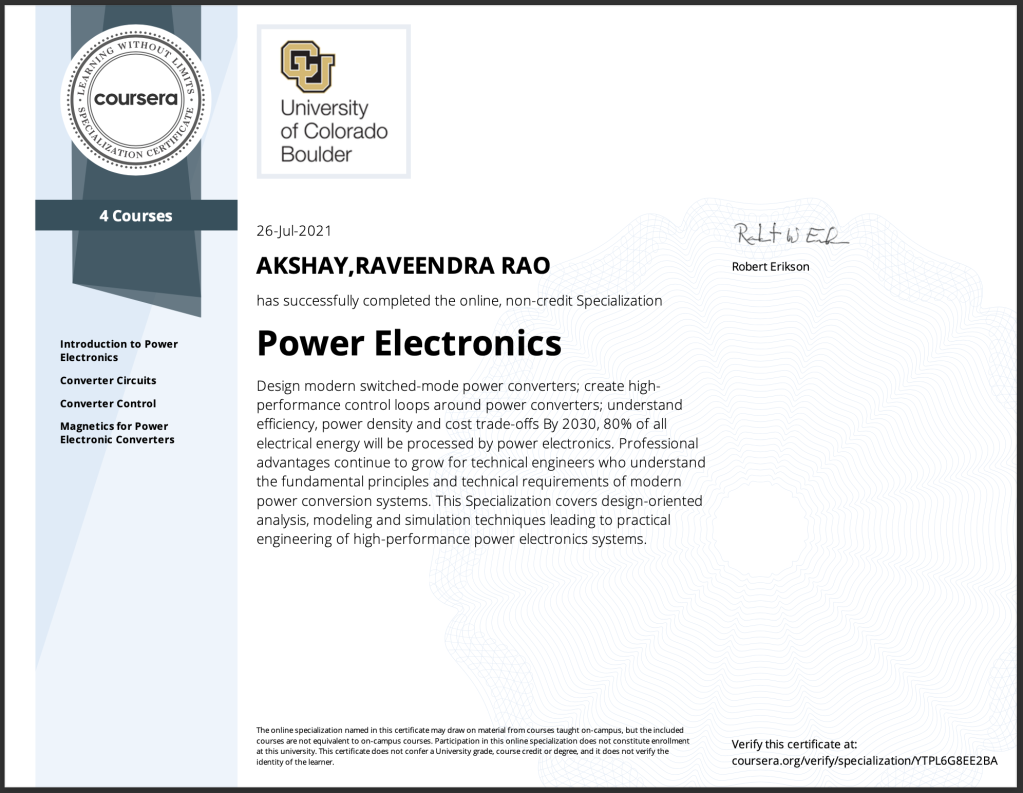
The four courses were: Introduction to Power Electronics, Converter Circuits, Converter Control, and Magnetics for Power Converters. In hindsight I really enjoyed the weekly quizzes because it forced me to focus on problems and find solutions. The most memorable material was using Kirchoff’s Current and Voltage Laws to solve switching converter circuits from buck to boost to buck-boost converters. I had to create a mathematical model for these circuits when operating, for example, a transistor in its ON and OFF states.
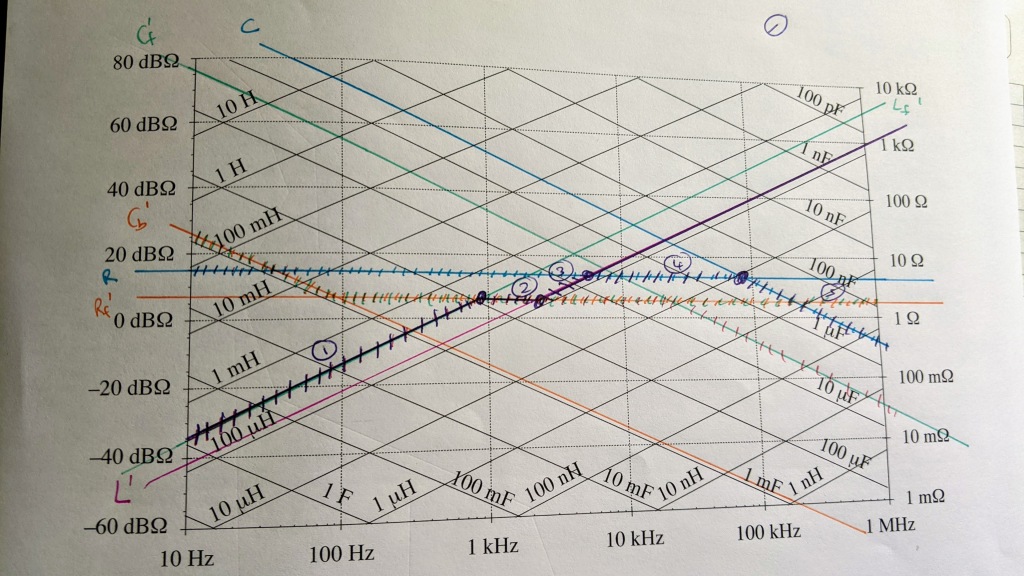
Moving into the Converter Control portion of the specialization I was reintroduced to bode plots. Specifically, superimposing the effects of resistors, capacitors, and inductors on one plot to create a system transfer function. Control theory has always been both confusing and very interesting.
Overall, this specialization was engaging and tough. I enrolled because, once through a private message, a potential employer asked me if I had any experience with power electronics. I didn’t so I said no. My job application ended right then. Now, I can say, “I don’t have experience…but I did complete a four month certificate in power electronics.”
 Akshay Rao